Azure is Microsoft’s public cloud platform. A .NET workload can use the Azure SDK, DefaultAzureCredential, and Microsoft Entra workload identities to call managed services without storing long-lived credentials. Those integrations can reduce identity and operations work when the organization already uses Azure, but they do not make Azure the automatic choice; region, service contract, portability, compliance, and total operating cost still decide.
# List subscriptions
az account list -o table
# Set active subscription
az account set --subscription "My Subscription"Choose Services by Capability
Start with the workload contract, not the product list. Decide how much runtime control the team needs, whether data is operational or analytical, the delivery semantics between components, regional availability, private-network requirements, and how much provider-specific API surface is acceptable.
| Capability | Representative services | Decision question |
|---|---|---|
| Compute | Virtual Machines, App Service, Container Apps, AKS, Functions | Do you need OS control, a managed web platform, container orchestration, Kubernetes APIs, or event-bound functions? |
| Storage | Blob Storage, Azure Files, Managed Disks | Is the data an object, a shared file, or a block device, and what redundancy/latency tier applies? |
| Relational data | Azure SQL, Azure Database for PostgreSQL/MySQL | Which engine semantics, compatibility, high-availability, and administrative controls are required? |
| Purpose-built data | Cosmos DB, Azure DocumentDB, Managed Instance for Apache Cassandra, Azure Managed Redis, Data Explorer | What data model, consistency, partitioning, query, and retention contract drives the workload? |
| Messages and events | Service Bus, Event Grid, Event Hubs, Storage Queues | Is the boundary a command queue, discrete event notification, telemetry stream, or simple storage-backed queue? |
| Integration | Logic Apps, Functions, Data Factory, API Management | Is the flow designer-led orchestration, code, data movement, or an API governance boundary? |
| Analytics | Fabric, Databricks, Data Explorer, Stream Analytics, Power BI | Is the stage ingestion, transformation, real-time analytics, governed warehouse/lakehouse, or presentation? |
| Networking | Virtual Network, Load Balancer, Application Gateway, Front Door, Private Link, VPN Gateway, ExpressRoute | Is traffic regional or global, public or private, layer 4 or layer 7, and hybrid or cloud-only? |
Use this page to translate capability needs into Azure product names. Provider-neutral mechanisms live in Object Storage, NoSQL, Networks, Message Queues, Event-Driven Architecture, and Kubernetes. Azure documentation owns current hosting plans, regional availability, quotas, pricing, and retirement state.
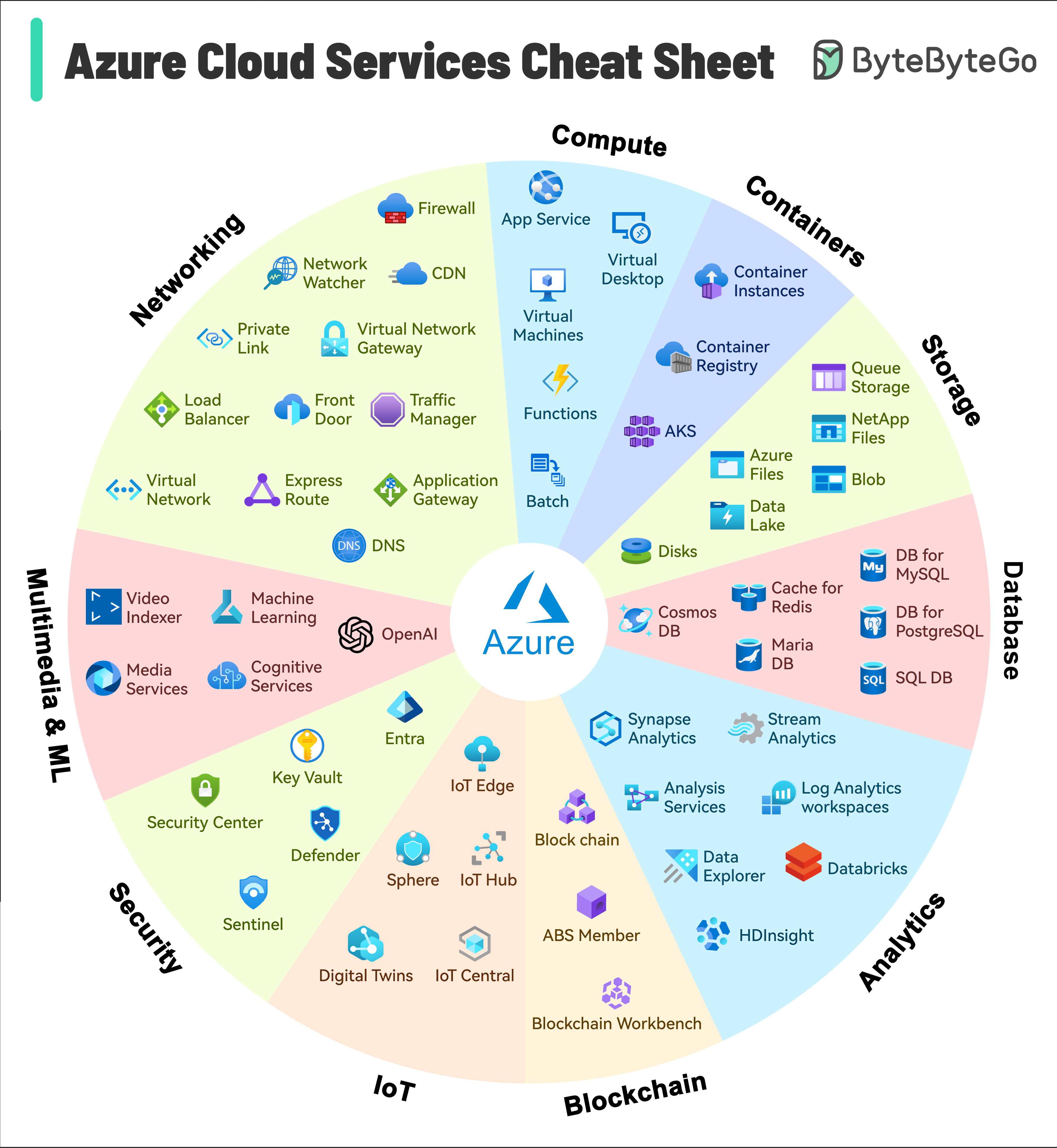
The visual is an orientation aid. Product names, retirement state, regional availability, quotas, and feature contracts must be checked against current Microsoft documentation. Portability is also a per-capability decision: container images can move more easily than Cosmos DB consistency or Service Bus settlement semantics.
Compute
Azure Functions
Azure Functions hosts event-driven code for HTTP, timer, queue, blob, Event Hubs, and Service Bus triggers. Scaling, idle capacity, billing, networking, and timeout depend on the hosting plan: Flex Consumption, Premium, Dedicated, legacy Consumption, and Container Apps are not interchangeable. Use asynchronous handoff or Durable Functions for long-running workflows rather than holding an HTTP request open, and make handlers safe for the trigger’s retry and duplicate-delivery behavior.
func init MyFuncApp --dotnet && cd MyFuncApp
func new --name Hello --template "HTTP trigger" --authlevel Anonymous
func start  # local dev
Storage
Azure Storage
Azure Storage is a family of distinct contracts: Blob Storage for objects, Azure Files for SMB/NFS shares, Queue Storage for simple queues, and Table Storage for key-value data. Choose by access semantics rather than treating the account as one generic store. Object Storage owns the object-key, multipart, lifecycle, and publication boundaries.
az storage account create --name mystorageacct --resource-group my-rg --sku Standard_LRS
az storage blob upload --account-name mystorageacct --container-name mycontainer --file ./data.csv --name data.csv
Azure Cosmos DB
Azure Cosmos DB is a distributed database family with several APIs and configurable consistency and multi-region write behavior. Reach for it only after fixing partition keys, query patterns, consistency, transactional scope, indexing, and request-unit cost. API compatibility does not make the service operationally identical to MongoDB, Cassandra, Gremlin, or another provider’s document database.
az cosmosdb create --name my-cosmos --resource-group my-rg --default-consistency-level SessionAI & ML
Azure OpenAI
Azure-hosted OpenAI models with enterprise controls such as RBAC, private networking, content filtering, and quota management. The v1 surface supports OpenAI clients with small code changes, but it is not endpoint-transparent: Azure uses an Azure resource endpoint, supports Azure-specific key or Microsoft Entra authentication, and requires the deployment name in the model parameter rather than only the underlying model name.
When to reach for it: Choose Azure OpenAI when the workload needs Azure-specific identity, private networking, policy, or governance integration, or supported residency and compliance controls. Verify that the chosen model, deployment type, feature, and Azure region satisfy those requirements; availability and compliance scope are not implied by selecting the service.
Microsoft Foundry
Microsoft Foundry, formerly Azure AI Foundry, is the unified Azure platform for building, evaluating, and operating AI applications. It groups model deployments, agents, tools, evaluators, tracing, monitoring, and governance under shared project and resource controls.
When to reach for it: Building RAG pipelines, agent systems, or any AI app that needs evaluation and safety controls. Replaces the older Azure AI Studio.
Azure Machine Learning
MLOps platform for training, tracking, evaluating, registering, and deploying ML models. Core concepts: Workspace (system of record), Compute (clusters/instances), Jobs (reproducible training runs), Model Registry (versioned promotion), Online Endpoints (real-time inference).
When to reach for it: Training custom ML models at scale, managing model lifecycle (train → evaluate → register → deploy → monitor), or running batch inference pipelines.
Azure AI Content Safety
Content filtering and safety controls for AI applications. Features include harmful-content classification, Prompt Shields, protected-material detection, and groundedness detection where the selected surface supports them. PII detection is a separate Azure Language in Foundry Tools capability; for supported LLM output filtering, Microsoft Foundry also exposes a distinct personal-information filter.
When to reach for it: Any production AI app that processes user input or generates user-facing content. Implement as a layer in your AI pipeline, not as an afterthought.
Azure Machine Learning Data Labeling
Managed labeling workflows within Azure Machine Learning. Supports image classification, object detection, text classification, and NER labeling tasks. Exported labels become CSV, COCO, or Azure MLTable data, depending on the project type. Register the export as a versioned data asset and pass that asset to training jobs; lineage records which jobs or pipelines consumed the data asset, while those jobs produce model artifacts separately.
When to reach for it: When you need to produce labeled training or evaluation data at scale with audit trails and quality controls.
Microsoft Foundry Evaluation and Observability
Microsoft Foundry provides evaluation runs, tracing, and monitoring for models and agents. Validate the availability and release status of each evaluator and observability feature in the target project type and region before making it a production gate.
When to reach for it: Before deploying any AI feature to production (offline evaluation), and continuously in production (online monitoring for drift and safety regressions).
References
- Azure documentation — Microsoft’s official Azure docs hub; starting point for any Azure service
- Azure SDK for .NET — .NET integration guide for Azure services; covers authentication, SDK packages, and samples
- Microsoft Foundry documentation — current documentation for Foundry models, agents, tools, evaluations, tracing, monitoring, and governance.
- Azure Functions hosting options — compares scaling, billing, timeout, networking, and container behavior across Flex Consumption, Consumption, Premium, Dedicated, and Container Apps.
- Switch between OpenAI and Azure OpenAI endpoints — documents Azure endpoint, authentication, and deployment-name differences when using OpenAI clients.
- Azure Language PII detection — the Foundry Tools surface for identifying and redacting personal information in text.
- Manage Azure Machine Learning labeling projects — documents label export formats and Azure MLTable data-asset output.
- Azure Machine Learning data assets — defines versioned data assets and lineage from assets to consuming jobs and pipelines.
- Azure Architecture Center — Technology choices — current decision guides across compute, storage, data, analytics, networking, messaging, and integration.
- Azure compute decision tree — chooses among managed compute options from workload shape and control requirements.
- Prepare to choose an Azure data store — current data-model and operational questions plus representative managed products.
- Compare Azure messaging services — official boundary among Event Grid, Event Hubs, and Service Bus.
- System Design 101 — Azure Services Cheat Sheet — visual catalog reorganized here around capability and verified with current Microsoft guidance.