Intro
Linux starts a filesystem permission check from the calling process’s filesystem user ID, group ID, supplementary groups, and capabilities. Traditional mode bits then select exactly one class—owner, group, or other—and apply its rwx bits. Access-control lists can add named users and groups, while mount options, immutable flags, and Linux security modules can impose further restrictions.
-rwxr-x--- means a regular file with owner rwx, group r-x, and other ---, written numerically as 0750. The leading character is the file type, not a permission bit.
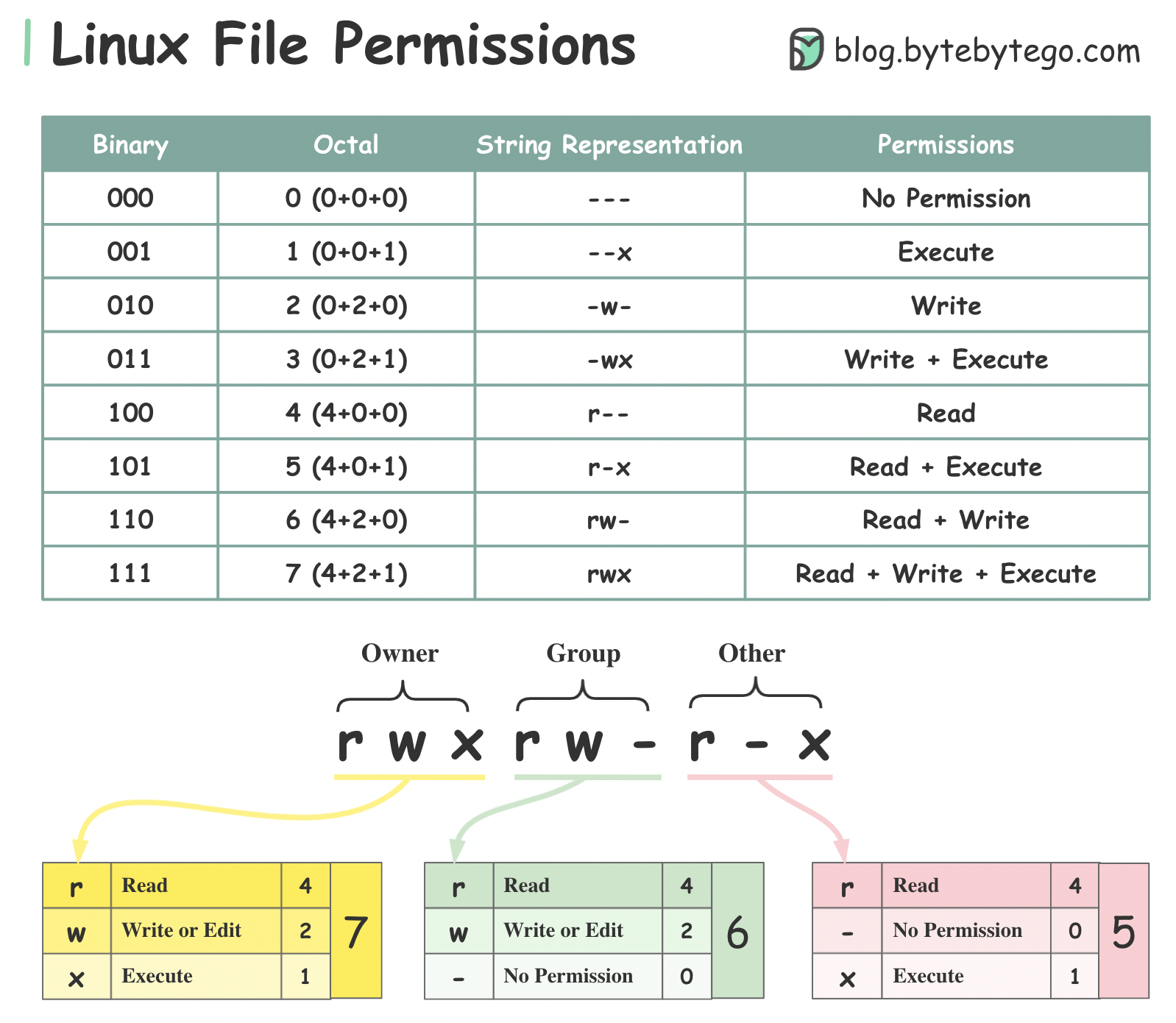
The visual covers regular rwx arithmetic. It does not cover directory semantics, special bits, capabilities, or ACL masks.
File and directory bits differ
| Bit | Regular file | Directory |
|---|---|---|
r (4) | Read bytes | List names in the directory |
w (2) | Modify bytes | Create, remove, or rename entries when traversal is also allowed |
x (1) | Execute as a program | Search/traverse the directory and access known entries |
Deleting a file is primarily an operation on its parent directory, not on the file’s own write bit. Every directory in a pathname also needs search permission unless a capability bypass applies.
Creation and special cases
A process proposes a mode and the kernel clears bits selected by the umask. With umask 0022, a requested regular-file mode of 0666 becomes 0644; a requested directory mode of 0777 becomes 0755. The application can request fewer bits, so umask does not grant permissions.
- set-user-ID / set-group-ID change execution credentials on eligible executable files; set-group-ID on a directory commonly makes new entries inherit the directory’s group.
- sticky on a shared writable directory restricts removal or rename to permitted owners, as on
/tmp. - POSIX ACLs add named user/group entries. The ACL mask limits the effective rights of named users, named groups, and the owning group.
Inspect the resolved state rather than only the three octal digits:
stat -c '%A %a %U:%G %n' ./artifact
namei -om /srv/app/artifact
getfacl ./artifact
References
- chmod(2) — authoritative Linux mode-bit and special-bit semantics.
- path_resolution(7) — authoritative pathname traversal and permission-check rules.
- umask(2) — creation-mode calculation and ACL interaction.
- acl(5) — POSIX ACL entries, masks, and access-check algorithm.
- ByteByteGo System Design 101 — Linux file permissions — editorial mode-bit overview and embedded visual; primary man pages supply the complete semantics.