SignalR is ASP.NET Core’s real-time communication framework for bidirectional server/client messaging over persistent connections. It is the default choice when the server must push updates immediately (chat, live dashboards, collaborative workflows, notifications) without polling-heavy architectures. Suppose a stock dashboard has 50,000 concurrent browser clients and otherwise polls every five seconds: that polling design creates 10,000 requests per second before accounting for retries or headers. SignalR can replace those repeated requests with pushed updates, but a target such as sub-100 ms delivery is a workload-specific service objective to measure under load, not a framework guarantee. SignalR hides transport negotiation details behind hubs, but production success still depends on scaling, connection lifecycle handling, and clear authorization boundaries.
How It Works
Mental Model
sequenceDiagram
  participant Client
  participant Hub as Hub runtime
  participant App as App service

  Client->>Hub: Connect and negotiate transport
  Hub->>App: Invoke hub method
  App->>Hub: Publish event/message
  Hub->>Client: Push update
SignalR negotiates the best available transport (WebSockets first, then fallback options). Hub methods are invoked per call on transient hub instances, and outbound messages are routed through Clients.* targets (All, User, Group, etc.).
Example
Hub:
public sealed class ChatHub : Hub
{
    public async Task Send(string message)
    {
        await Clients.All.SendAsync("message", message);
    }
}
Register in ASP.NET Core pipeline:
builder.Services.AddSignalR();

var app = builder.Build();
app.MapHub<ChatHub>("/hubs/chat");
app.Run();
Pushing from outside a hub
Most real apps push messages from a controller or background service, not from inside a hub method. Inject IHubContext<THub> to do that:
public sealed class PriceUpdater(IHubContext<PriceHub> hub)
{
    public Task BroadcastAsync(decimal price, CancellationToken ct) =>
        hub.Clients.All.SendAsync("price", price, ct);
}
Streaming and client results
- Streaming: a hub method returning
IAsyncEnumerable<T>(or accepting aChannelReader<T>) streams items incrementally instead of one big payload — good for live feeds and large transfers with backpressure. - Client results (.NET 7+): the server can invoke a method on a client and await its return value with
Clients.Client(id).InvokeAsync<T>(...)— turning the normally fire-and-forget push into a request/response.
Connection lifecycle
Override OnConnectedAsync / OnDisconnectedAsync to manage group membership and presence. The client supports automatic reconnect (.WithAutomaticReconnect()), but reconnection assigns a new ConnectionId, so re-add the connection to its groups on reconnect. SignalR has no built-in durable replay: a message sent while a client is disconnected is not replayed when it returns. Delivery guarantees depend on the configured path; the Redis Pub/Sub transport used by the Redis backplane is formally at-most-once and loses messages that a subscriber misses during a disconnect or outage. Persist anything that must survive a disconnect (DB/queue) and replay it explicitly.
Redis backplane request and delivery path
A Redis backplane solves cross-node routing; it does not make chat messages durable. One scale-out path is:
- The client negotiates a transport, authenticates, and opens a connection to node A. SignalR associates its user identifier, groups, and connection ID with that live connection.
- Bob invokes
SendMessage. Node A authorizes the conversation and commits{ messageId, conversationId, senderId, body, createdAt }to durable storage. If persistence and publication must be atomic across a crash, an outbox publishes after the database commit. - Node A sends a delivery envelope through SignalR. The Redis backplane uses Pub/Sub to fan it to the app nodes; node B recognizes Alice’s connection and pushes the envelope over her active transport.
- Alice renders the message and invokes an explicit
Ack(messageId). The server records the acknowledgement independently. Completion ofClients.User(...).SendAsync(...)means the server-side send path completed, not that Alice displayed or persisted the message. - After a disconnect, Alice queries durable storage from her last acknowledged sequence and catches up. Redis Pub/Sub cannot replay anything published while node B or Alice was unavailable.
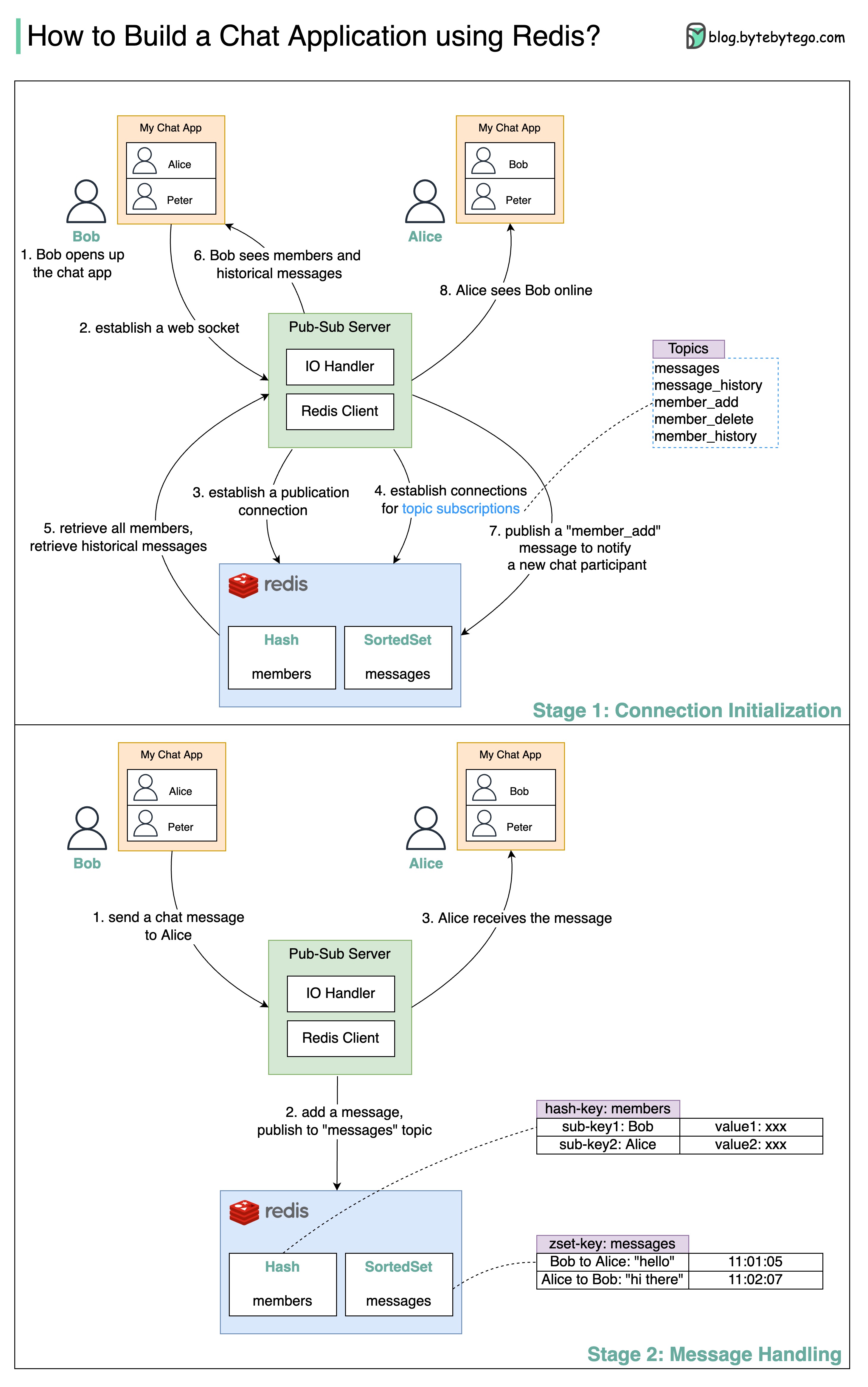
The diagram combines Pub/Sub and Redis data structures in one product. A SignalR Redis backplane specifically uses transient Pub/Sub; message history needs a separate durable design. Redis Streams or another broker/store can provide persistence, but that is not the behavior of the backplane configured by AddStackExchangeRedis.
Pitfalls
- Assuming hub instances are stateful leads to lost data because hubs are transient per invocation; keep connection/session state in
Context.Itemsor external stores. For example, if a team stores a shopping cart in a hub field, the next invocation receives a new hub instance and observes an empty cart. The defect can remain hidden until a multi-call workflow or reconnect path exercises it. - Skipping
awaitonSendAsynccan drop messages when hub execution completes before send operations finish. - Treating groups as authorization boundaries is unsafe: groups are routing constructs, not security policy enforcement.
- Multi-node deployments fail unpredictably without a scale-out plan (Azure SignalR Service or backplane) and correct session-affinity assumptions. A 4-node deployment without a backplane delivers messages only to clients connected to the originating node — roughly 75% of connected clients silently miss every broadcast, and the bug only manifests under load when connections distribute across nodes. The fix is a backplane (
AddStackExchangeRedis(...)) that fans every message out to all nodes, or Azure SignalR Service which offloads connections entirely. Either way self-hosted SignalR needs sticky sessions (ARR affinity), because the initial negotiate and the transport connection must land on the same node — unless you disable the negotiate step or use the managed service. - Forgetting that the transport falls back (WebSockets → Server-Sent Events → Long Polling) when WebSockets are unavailable. Long Polling especially amplifies the sticky-session requirement and the cost of a missing backplane; verify your proxy/load balancer allows WebSocket upgrades so you actually get the fast transport.
Tradeoffs
- SignalR vs polling: SignalR gives lower latency and better network efficiency for frequent updates, while polling is simpler for low-frequency/eventually-consistent scenarios.
- Azure SignalR Service vs self-managed backplane: managed service reduces operational burden and sticky-session complexity, while self-managed options provide more infrastructure control.
- JSON vs MessagePack protocol: JSON is easier to debug and interoperate with, while MessagePack reduces payload size for high-throughput workloads.
Questions
When is SignalR a good fit?
- Use SignalR when clients need server-pushed updates with low latency (chat, collaboration, live telemetry).
- It is most valuable when update frequency is high enough that polling wastes bandwidth or increases staleness.
- If updates are rare and latency tolerance is high, simpler HTTP polling can be cheaper to operate.
What is the first scaling problem you will hit?
- Cross-node message fan-out: messages sent on one server do not automatically reach clients connected to another node.
- Plan scale-out early with Azure SignalR Service or a supported backplane, then validate routing under load tests.
- Also validate sticky-session requirements for your chosen topology and transport strategy.
Why are SignalR groups not enough for authorization?
- Groups control message routing, not permission checks.
- Membership can change/rejoin over reconnect paths, so relying on groups alone risks privilege drift.
- Enforce security with authentication and policy/role-based authorization on hub methods.
References
- ASP.NET Core SignalR - Official architecture and transport overview.
- Use hubs in SignalR for ASP.NET Core - Hub lifecycle, targeting APIs, and error handling.
- Scale ASP.NET Core SignalR - Scale-out models, sticky sessions, and hosting constraints.
- Redis backplane for ASP.NET Core SignalR - Backplane configuration, same-datacenter guidance, and message loss during Redis outages.
- Redis Pub/Sub delivery semantics - Official at-most-once semantics and the distinction from persisted Redis Streams.
- Authentication and authorization in SignalR - Auth flows, token handling, and security rules.
- Build a simple chat application (ByteByteGo, pinned source) - Provenance for the Redis chat visual; the note separates transient backplane delivery from durable history and explicit acknowledgement.
- Scaling SignalR at production scale (Ably) - Practical scaling tradeoffs and operational pitfalls.