Intro
A chat system is an ordered event store with real-time delivery attached. A WebSocket tells the server where an online device is connected; it does not make the message durable, establish conversation order, or prove that another device displayed it. Store those facts separately.
Durable Append and Conversation Order
The sender supplies a stable client_message_id. The conversation owner validates membership, assigns a monotonically increasing sequence within that conversation, appends the event, and returns the stored ID. A retry with the same client ID returns the existing event instead of creating another message.
conversation_42: 1087  Alice  "ship it"      accepted
conversation_42: 1088  Bob    "deploying"    accepted
Ordering per conversation is usually enough. A global sequence would coordinate unrelated chats and become a throughput bottleneck. Partition by conversation ID, but keep one ordering authority for a conversation at a time and fence an old owner after reassignment.
Delivery and Multi-Device Synchronization
Persist before fan-out. Online devices receive the event through their current gateway connection; offline devices receive a push wake-up and later pull events after their last durable cursor. Track separate evidence:
accepted: the server stored the event;delivered: a recipient device acknowledged receipt;read: the user advanced a read cursor;push_submitted: a push provider accepted a notification request.
None implies the next. A user with a phone and laptop needs per-device delivery cursors but usually one user-level read position. Reconnect with after_sequence=1084 and replay the gap before switching to live events.
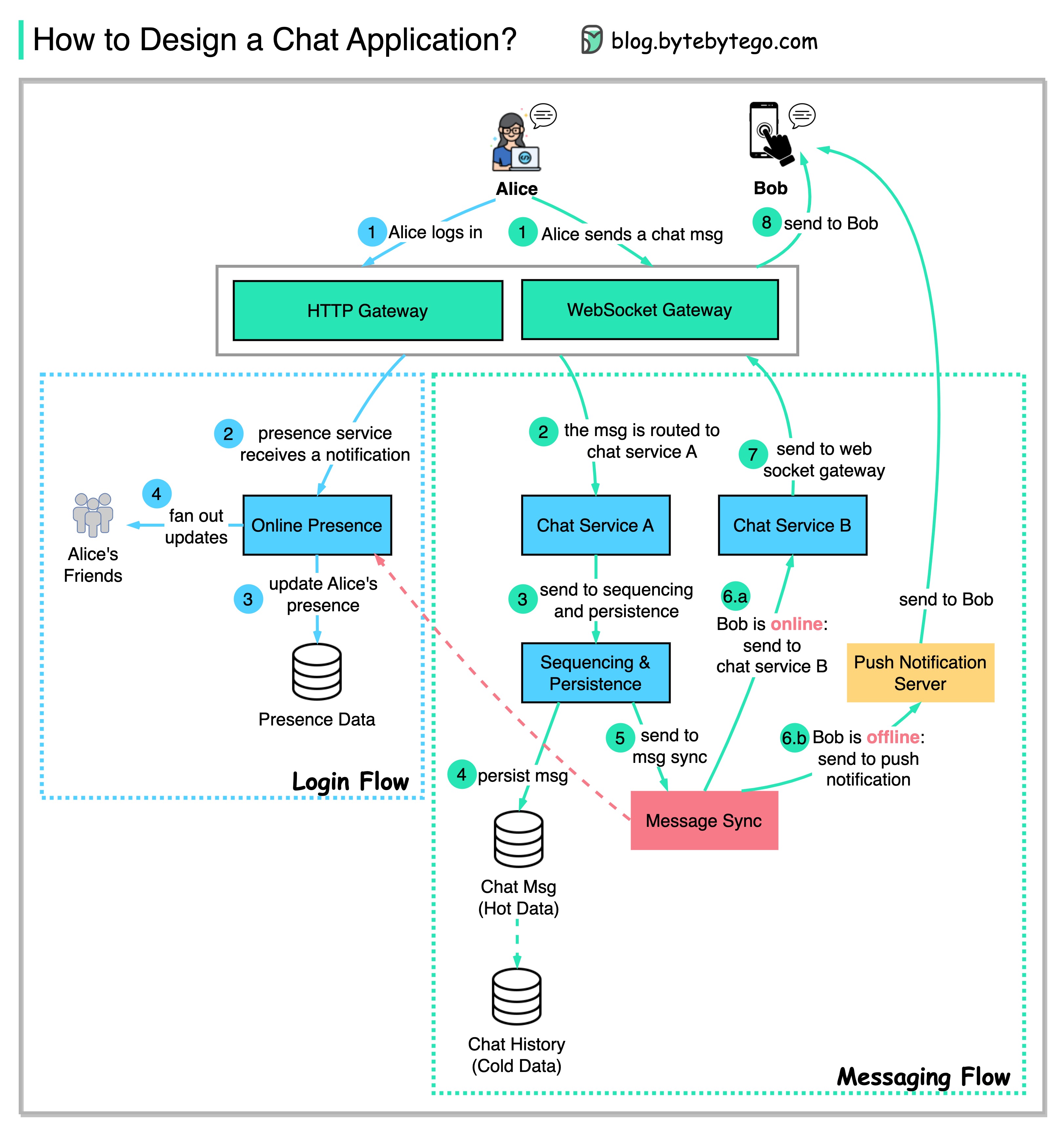
The visual is a useful topology, not a delivery contract. The sequencing store must define duplicate suppression and partition ownership; presence is soft state; push is only an offline wake-up path.
Presence Is Soft State
Presence expires unless refreshed. A gateway heartbeat can renew user_7/device_phone -> gateway_3 for 45 seconds. A network pause can make an online user look offline, so presence may guide fan-out but must not decide whether a message exists. Last-seen timestamps also need a privacy policy and coarse visibility controls.
References
- RFC 6455: The WebSocket Protocol — IETF framing, connection, ping/pong, and closing semantics for the real-time transport.
- RFC 8030: Generic Event Delivery Using HTTP Push — IETF model for push subscriptions, TTL, acknowledgement, and delivery limitations.
- Matrix client-server specification — open protocol definitions for room event ordering, synchronization tokens, receipts, and device state.
- ByteByteGo: design a chat application — provenance for the gateway, sequencing, persistence, synchronization, presence, and push topology.