A large language model (LLM) is a neural language model trained at enough scale to handle a broad range of language tasks. The name says little about the exact architecture. Decoder-only models continue text causally, encoder-decoder models generate from an encoded source, and encoder-only models produce contextual representations instead of open-ended text.
Model output is probabilistic and untrusted from a system-design perspective. A prompt conditions behavior, context supplies current evidence, and the harness exposes actions. The loop controls iteration and stopping. Evaluation then measures whether those pieces work together. Fluent output remains a candidate result until grounding and validation support it.
Engineering Routes
Four inference-time disciplines form the runtime around a model call:
flowchart LR
    P[Prompt Engineering<br>instruction] --> C[Context Engineering<br>evidence and budget]
    C --> H[Harness Engineering<br>tools and environment]
    H --> L[Loop Engineering<br>iteration and stopping]
| Route | Unit of design | Question |
|---|---|---|
| Prompt Engineering | One instruction | How should this task be specified and demonstrated? |
| Context Engineering | The whole context window | Which evidence enters the window, in what order, and at what cost? |
| Harness Engineering | Tools and execution boundary | What can the model do, and through which constrained interface? |
| Loop Engineering | Runtime across turns | How does work iterate, verify, recover, and stop? |
Evaluation and Safety span every route. Model-level choices sit underneath them: generation controls decoding, embeddings represent inputs for retrieval, fine-tuning adapts behavior, and model selection and routing chooses which model serves a request.
At the application level, these disciplines become connected runtime subsystems rather than isolated techniques. This intentionally broad sketch shows one possible composition of request routing, retrieval, shared model access, agents, memory, tools, ingestion, and cross-cutting controls.
Transclude of assets/excalidraw/imaginary-ai-system-architecture.excalidraw
Transformer Foundations and Training
An LLM checkpoint comes from one architecture, tokenizer, objective, and training pipeline. Its weights are not a self-describing program. A compatible runtime must rebuild the expected computation graph, interpret the stored tensors correctly, apply the matching tokenization rules, and provide every operator required by the architecture and quantization scheme.
Transformer Families
| Family | Training and attention boundary | Output path | Typical use |
|---|---|---|---|
| Encoder-only | Bidirectional contextual encoding. BERT pretrains with masked-token prediction and sentence-level objectives | One contextual vector per input token or a pooled representation | Classification, extraction, reranking, embeddings |
| Encoder-decoder | Encoder reads the source bidirectionally. Decoder generates target tokens autoregressively while attending to encoder output | Generated target sequence | Translation, summarization, text-to-text tasks |
| Decoder-only | Causal attention exposes only earlier tokens during next-token prediction | Generated continuation | Chat, code, completion, tool-call generation |
BERT is encoder-only. It predicts masked tokens during pretraining and exposes contextual representations to a task head. It has no autoregressive decoder for open-ended generation.
T5 is a generative encoder-decoder. It pretrains with a span-corruption text-to-text objective: the encoder consumes corrupted input, and the decoder autoregressively generates missing target spans.
GPT-style models are decoder-only. A causal mask makes each position predict from earlier positions, so the same stack can continue a prompt one token at a time.
Checkpoint is More than Weights
Loading is trustworthy only when several contracts agree:
- Architecture and configuration define the layer count, hidden size, attention layout, positional encoding, normalization, activation, vocabulary size, and expert topology.
- Tensor contract covers parameter names, shapes, axis layout, serialization, numerical type, sharding, and any fused or transposed representation.
- Tokenizer contract includes the vocabulary, normalization, splitting and merge rules, byte fallback, and special-token identifiers.
- Adaptation and quantization metadata record adapter targets and scaling alongside quantization groups, scales, zero points, and calibration assumptions.
- Runtime operators must implement compatible attention, position logic, expert routing, normalization, quantized matrix work, and cache layout on the target hardware.
A .safetensors file provides a safe tensor container, not a model class or tokenizer. Llama-shaped tensors do not fit a GPT-2 graph. A wrong tokenizer is harder to spot: tensor dimensions still match while the same text maps to different IDs, silently changing behavior.
Portable graph formats such as ONNX make operators and tensor interfaces explicit. The target runtime still needs the graph’s operator versions, data types, custom operators, and hardware kernels. Parsing the file proves less than a known-answer inference test against the source runtime.
Training Pipeline
base checkpoint = architecture + tokenizer + pretrained tensors + configuration
instruction model = compatible base checkpoint + SFT + optional preference/reward stage
deployable artifact = model bundle + runtime + release evaluation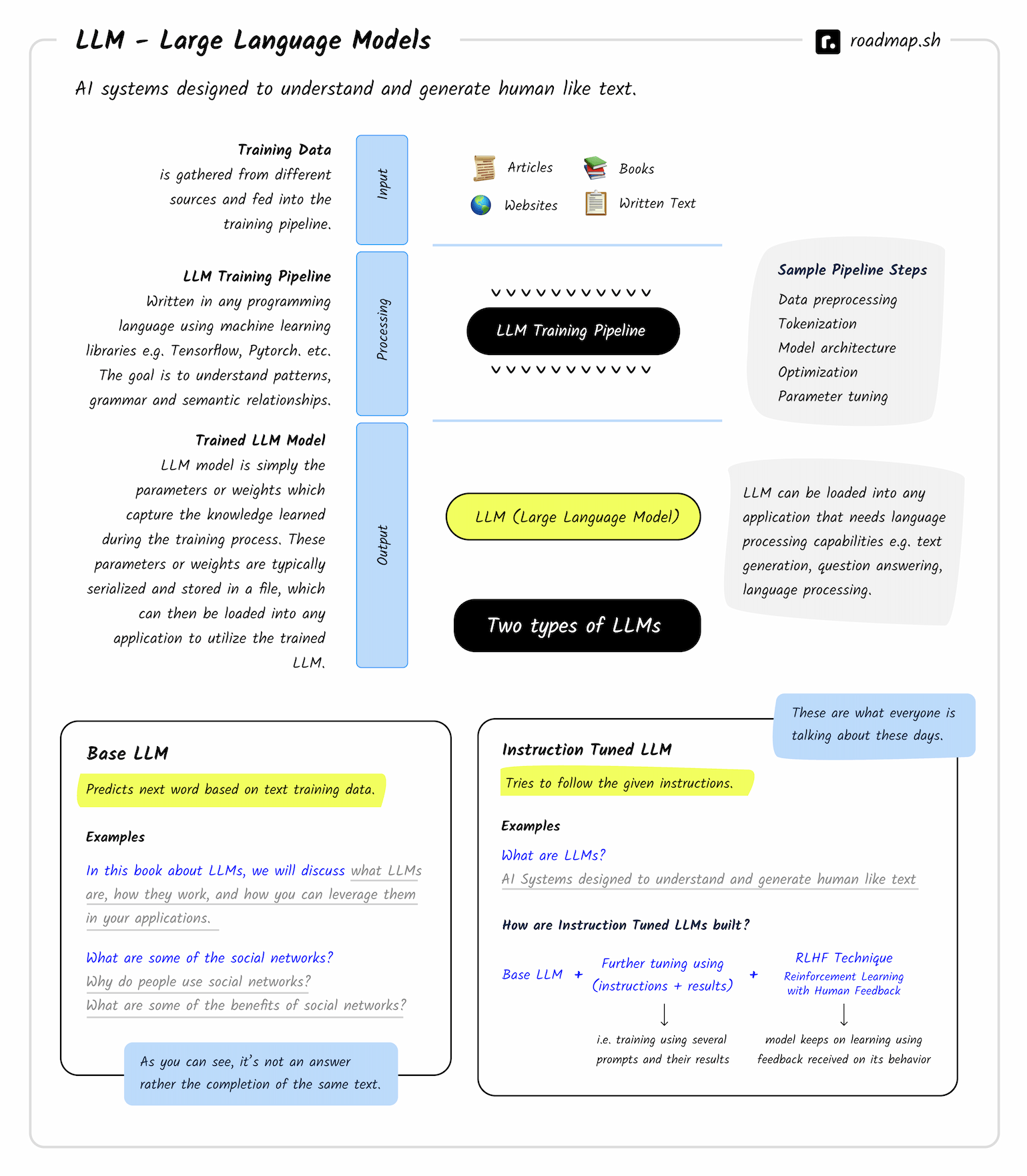
- Pretraining fits the architecture’s language objective over a large corpus. The output is a base checkpoint, not automatically a conversational assistant.
- Supervised fine-tuning (SFT) trains on instruction-response or task examples. Fine-tuning covers full and parameter-efficient updates, data contracts, preference alignment, GRPO, and evaluation.
- Preference or reward optimization uses comparisons or verifiable rewards to favor some outputs over others. It remains a separate training stage even when documented in the same canonical note as fine-tuning.
Deployment depends on training provenance. The release record needs the base revision, data version, tokenizer files, configuration, adapters, quantization recipe, runtime version, and evaluation result. A model name alone cannot reproduce an output or explain a regression.
Failure Modes
- Architecture mismatch — tensor names or shapes fail during load, or a permissive loader leaves expected parameters uninitialized.
- Tokenizer mismatch — loading appears successful, but prompts use different token IDs, special markers, or normalization and quality collapses.
- Runtime mismatch — unsupported operators, cache layout, precision, or quantization kernels cause load failure, numerical drift, or a slow fallback path.
- Training-stage ambiguity — benchmark results for a base checkpoint are compared with an instruction or preference-aligned variant as though they were the same model.
Mixture-of-experts
A sparse mixture-of-experts (MoE) model replaces some dense feed-forward layers with expert networks and a learned router. The router activates only a small subset for each token, then combines their outputs. This adds total parameter capacity without evaluating every expert on every token. It is an internal architecture choice, separate from application-level model selection and routing.
Token Routing
token hidden state
    → router scores experts
    → select top-k experts
    → dispatch token
    → combine weighted expert outputs
When too many tokens choose one expert, its device becomes a bottleneck while others sit idle. Implementations counter this with capacity limits, balancing objectives or biases, token rerouting, and deliberate expert placement.
What Sparse Activation Saves
Sparse activation saves feed-forward arithmetic compared with evaluating every expert. The rest of the transformer still runs, and the full parameter set still affects deployment.
Three measurements describe different costs:
- Total parameters affect checkpoint storage and expert placement across device memory.
- Active parameters per token approximate part of the arithmetic executed for a token.
- Measured throughput and latency include router work, token dispatch, all-to-all communication, batching, precision, kernels, and load imbalance.
A dense model can beat a sparse model with a similar advertised active count when expert traffic is communication-bound. Careful expert placement can give an MoE more learned capacity at manageable per-token compute. Parameter counts alone cannot predict either result.
Capacity and Communication
An expert capacity factor reserves headroom above the average token share. Too little capacity drops or reroutes tokens. Too much wastes memory and compute. In distributed training or serving, tokens cross device boundaries to reach experts, so interconnect topology and placement become part of model latency.
Batch shape changes that tradeoff. Large batches can spread tokens across experts efficiently, while small low-latency batches expose imbalance and communication overhead. Training throughput is not a substitute for measurement on the intended serving workload.
Routed and Shared Experts in DeepSeek-V3
The DeepSeek-V3 report describes routed experts, shared experts, and an auxiliary-loss-free load-balancing strategy. DeepSeek-R1 uses that base architecture, while GRPO belongs to post-training. Token routing and policy optimization solve different problems. Price, hardware, and benchmark comparisons are meaningful only when hardware, precision, prompts, and model versions match.
Minimal Vocabulary
- Token — the integer-id unit produced by a specific tokenizer. Tokenizer choice affects sequence length and must match the checkpoint.
- Context window — the token budget visible to one model invocation, including instructions, history, evidence, tool results, and output allowance.
- Inference — executing a trained model to produce representations or generated tokens. generation covers sampling controls for generative models.
- Embedding — a vector representation used for similarity or downstream prediction. Covered in embeddings.
Questions
How do encoder-only, encoder-decoder, and decoder-only transformers differ?
The three families differ in which transformer stacks they use, and therefore in how attention sees the input and what the model produces. Encoder-only models build contextual representations of an input. Decoder-only models generate a continuation one token at a time. Encoder-decoder models read a source sequence and generate a separate target sequence.
Aspect Encoder-only (BERT) Encoder-decoder (T5) Decoder-only (GPT-style) Attention Bidirectional: every token can attend to the whole input The encoder reads the source bidirectionally; the decoder attends causally to its own earlier tokens and to the encoder’s output Causal: each position attends only to earlier positions Pretraining objective Predict masked tokens from the context on both sides The encoder reads input with spans removed, and the decoder generates the missing spans Predict the next token Output One contextual vector per token, or a pooled vector, passed to a task head A generated target sequence A generated continuation of the prompt Typical use Classification, extraction, reranking, embeddings Translation, summarization and other text-to-text tasks Chat, code, completion, tool-call generation An encoder-only model has no autoregressive decoder, so it is not used for open-ended generation. The causal mask is what lets one decoder-only stack train on next-token prediction and then continue a prompt token by token. The typical uses describe common fits, not hard limits.
Sources: Attention Is All You Need · BERT · T5: Exploring the Limits of Transfer Learning with a Unified Text-to-Text Transformer · Language Models are Few-Shot Learners
How should prompting, RAG, and fine-tuning be chosen for an LLM system?
The choice follows the gap that evaluation reveals. A behavior gap is first addressed with clearer instructions and examples. A knowledge gap is closed by putting the facts into context. Small, stable facts can be written directly into the prompt. Large, private or changing facts are retrieved per request with RAG. Fine-tuning addresses behavior that stays inconsistent after prompt work. The techniques solve different problems and can be combined.
Technique What it changes Fits when Main limit Prompting The instructions, examples and any fixed reference text sent with each request The model can do the task but needs a clearer specification, output format or examples, or the facts it needs are few and stable enough to write into the prompt Instructions alone add no knowledge. Facts written into the prompt are fixed in advance and add tokens to every call, so this approach does not scale to large or changing knowledge RAG The evidence selected and placed in the context at request time Answers depend on current, private or citable information that is too large or changeable to include in every prompt Answer quality is limited by retrieval quality, and retrieved text does not reliably teach a new format or style Fine-tuning The model’s weights, through training on examples Format, style or task behavior remains inconsistent after prompt work It needs training data and evaluation, and facts stored in weights are harder to update than retrieved documents Prompting is the usual starting point because it is the cheapest to iterate, but this is a diagnostic default, not a mandatory sequence. A fine-tuned model can still use RAG: training shapes behavior while retrieval supplies changing facts. Each change is compared on the same representative evaluation set, so an improvement can be attributed to that change.
Source: OpenAI: Optimizing LLM accuracy
How does a sparse mixture-of-experts model work, and what does sparse activation actually save?
A sparse mixture-of-experts (MoE) model replaces some dense feed-forward layers with several expert networks and a learned router. Each token is processed by only a few selected experts. Compared with evaluating every expert on every token, this saves feed-forward arithmetic, so total parameter capacity can grow while per-token computation stays roughly constant. It does not shrink the parameter footprint: every expert still has to be stored and placed in device memory, and the rest of the transformer still runs for every token.
Routing a token through an MoE layer:
- The router scores every expert for the token’s hidden state.
- The top-k experts are selected.
- The token is dispatched to those experts, possibly on other devices.
- Their outputs are combined using the router’s weights.
Measure What it reflects Total parameters Checkpoint size and the device memory needed to hold every expert Active parameters per token Part of the arithmetic performed for each token Measured latency and throughput Arithmetic plus router work, cross-device dispatch, load imbalance, batching and kernels If many tokens choose the same expert, its device becomes a bottleneck while others sit idle. Capacity limits and load-balancing objectives counter this. Depending on the implementation, tokens beyond an expert’s capacity are dropped or rerouted.
The saving is relative to evaluating all experts. It is not a guaranteed advantage over every alternative. A dense model with a similar number of active parameters can be faster than an MoE when expert traffic is communication-bound, because the MoE also pays for routing, dispatch and imbalance. Parameter counts alone cannot predict either outcome. Only measurement on the intended serving workload shows the real cost.
MoE routing happens inside one model and is separate from application-level routing between different models.
Source: Switch Transformers