A time-series database organizes timestamped observations for ordered range reads and time-window calculations. It earns its place when ingest rate, retention, compression, or repeated window queries dominate storage cost. A timestamp column alone is not enough. PostgreSQL with time partitioning may handle a moderate workload cleanly. A specialized engine becomes useful when series indexing, compressed chunks, and rollups are the limiting work.
Series and Cardinality
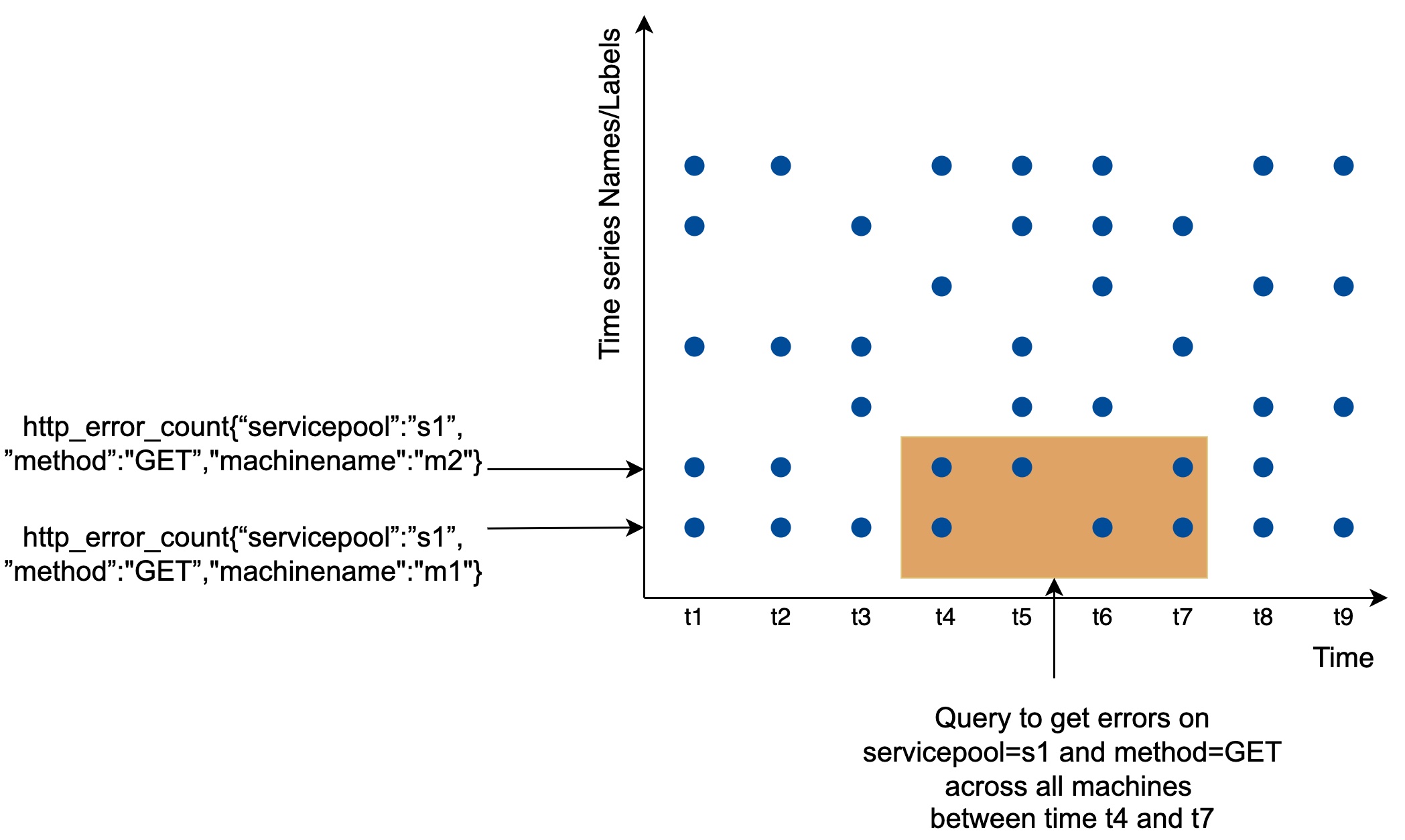
In Prometheus, a series is the metric name plus its complete label set:
http_request_duration_seconds_count{service="checkout",method="POST",status="200"} 8431 1721044800000Changing one label value creates another series. Bounded labels such as service and status make useful dimensions. An unbounded label such as user_id can create a series per user, growing the index and active-series memory until ingestion or queries become too expensive.
Storage Decisions
| Decision | Engine behavior | Failure mode when wrong |
|---|---|---|
| Series key | Index a stable metric name and bounded labels | Unbounded labels exhaust memory and index space |
| Time partition | Keep chunks or partitions ordered by time | Range reads and retention deletion scatter across storage |
| Retention | Drop whole expired chunks or partitions | Row-by-row expiry amplifies writes and compaction |
| Rollups | Persist lower-resolution aggregates | Long dashboards repeatedly scan raw samples |
| Late data | Define an allowed lateness window | Old samples rewrite sealed chunks or disappear from aggregates |
The diagram is a workload selector. A metrics system does not automatically need a dedicated TSDB. Measured series cardinality, ingest rate, retention volume, and query windows decide.
Rollups Cap Repeated Scans
At 10,000 samples per second, 15 days of raw retention contains about 13 billion samples. Recomputing every 5-minute rate from that raw history makes each dashboard revisit the same data. Time-partitioned raw chunks plus a persisted 5-minute rollup bound the query input, and expired raw data can leave as a whole partition. That saves read work but adds write amplification and a repair rule for samples that arrive after a rollup was built.