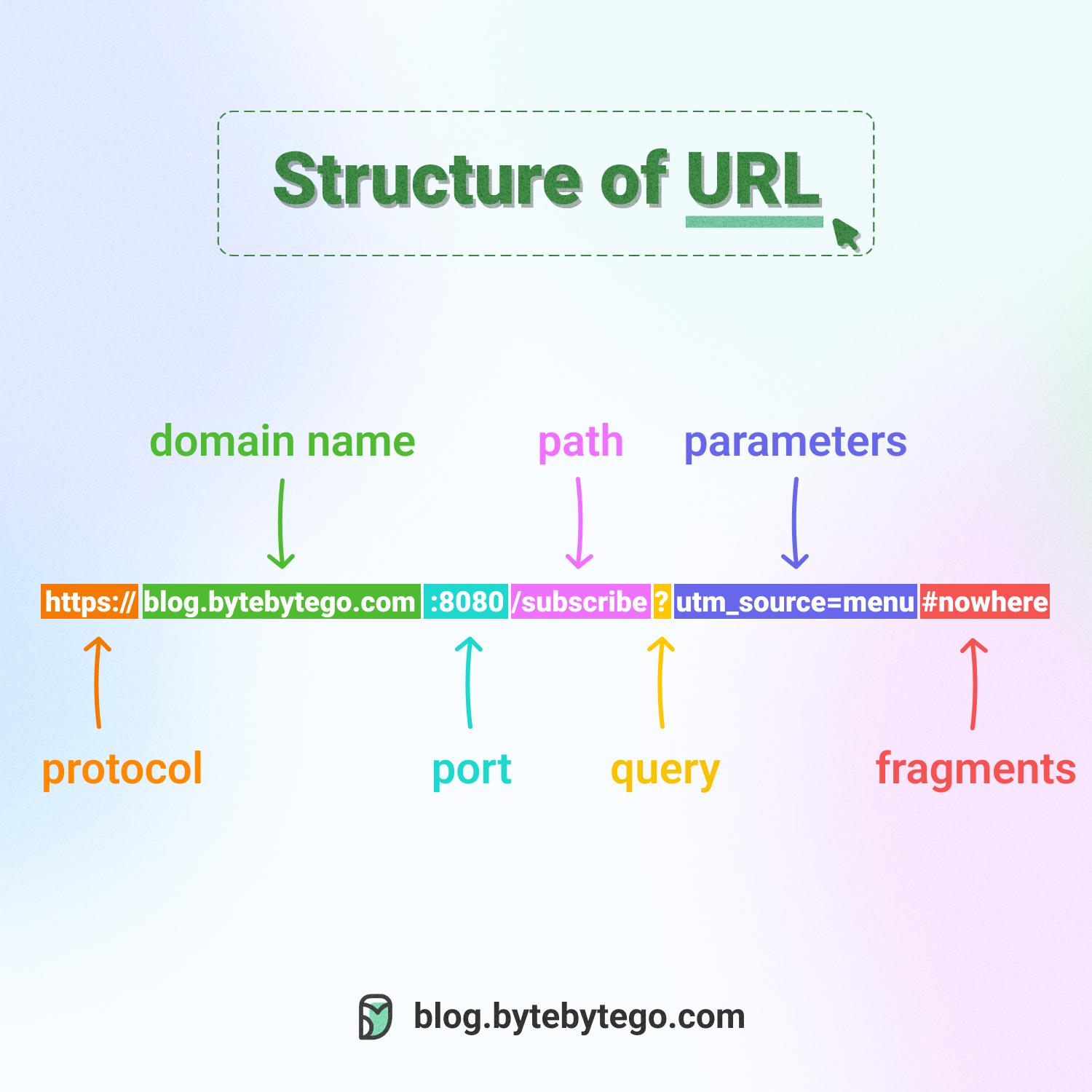
A URL identifies how and where a resource can be accessed. Browsers parse URLs with the WHATWG algorithm. Network protocols and many non-browser systems also rely on the generic URI syntax from RFC 3986. The distinction matters because string concatenation, premature decoding, or inconsistent normalization can change the origin, cache key, signature input, or routed resource.
https://user@example.com:8443/orders/42?view=compact#history
\___/   \___________________/ \________/ \__________/ \_____/
scheme         authority          path       query     fragment
The authority contains optional user information, a host, and an optional port separated by :. An IPv6 literal must be bracketed: https://[2001:db8::7]:8443/. The fragment is interpreted by the client and is not sent in an HTTP request. Query syntax is owned by the application. ?a=1&a=2, parameter order, and + decoding do not have one universal meaning outside the chosen form or API contract.
Parsing and Encoding
Percent-encoding represents bytes that cannot appear directly in a component. Component splitting must happen before decoding because %2F can turn path data into a separator. A second decode is also unsafe: %252F becomes %2F and then /, a common path-traversal and signature-bypass bug.
Relative references resolve against a base URL. From https://example.com/a/b/, ../c?x=1 resolves to https://example.com/a/c?x=1. A leading //cdn.example.net/app.js keeps the base scheme but replaces the authority.
Normalization is context-sensitive. Scheme and host comparison is case-insensitive, while path segments may be case-sensitive. Removing a default port or resolving dot segments can be safe for some protocols. Sorting query parameters or decoding reserved characters can change application meaning. A standards-aware URL type preserves component boundaries, and signatures must use the exact canonical form defined by the protocol.
URI Examples
- URL:
https://example.com/docs?q=uri#syntax - Email URI:
mailto:alice@example.com— no//authority form. - LDAP URI with IPv6:
ldap://[2001:db8::7]/dc=example,dc=com - URN:
urn:isbn:9780131103627— a persistent name, not a network location.