Concurrency describes program structure: several operations can be in progress during the same period. Parallelism describes execution: several operations run at the same instant. A single core can interleave concurrent work but cannot execute it in parallel.
That distinction drives the .NET choices in this folder. Asynchronous composition keeps I/O waits from occupying threads. Controlled parallelism gives CPU work access to multiple cores. Mixing the two models usually adds threads without making the workload finish sooner.
Composition versus Simultaneous Execution
A single thread can compose overlapping I/O without running two instructions at once:
- At 0 ms, request A sends an HTTP call and registers its continuation with
await. The thread returns to the scheduler. - At 1 ms, the same thread starts request B and yields at its
await. - At 40 ms, B’s socket completion makes its continuation runnable. The thread processes it.
- At 52 ms, A becomes runnable and the thread resumes it.
Both requests were in flight together. The thread still executed one continuation at a time because the overlap came from the operating system and network.
CPU work crosses a different boundary. This loop partitions the pixels and schedules workers through the ThreadPool. Multiple workers can execute Sharpen simultaneously on different cores:
Parallel.For(
    fromInclusive: 0,
    toExclusive: pixels.Length,
    new ParallelOptions { MaxDegreeOfParallelism = Environment.ProcessorCount },
    i => pixels[i] = Sharpen(pixels[i]));
That is useful only when Sharpen does enough computation to repay partitioning and scheduling overhead. For socket waits, adding worker threads consumes resources without making the remote service respond sooner.
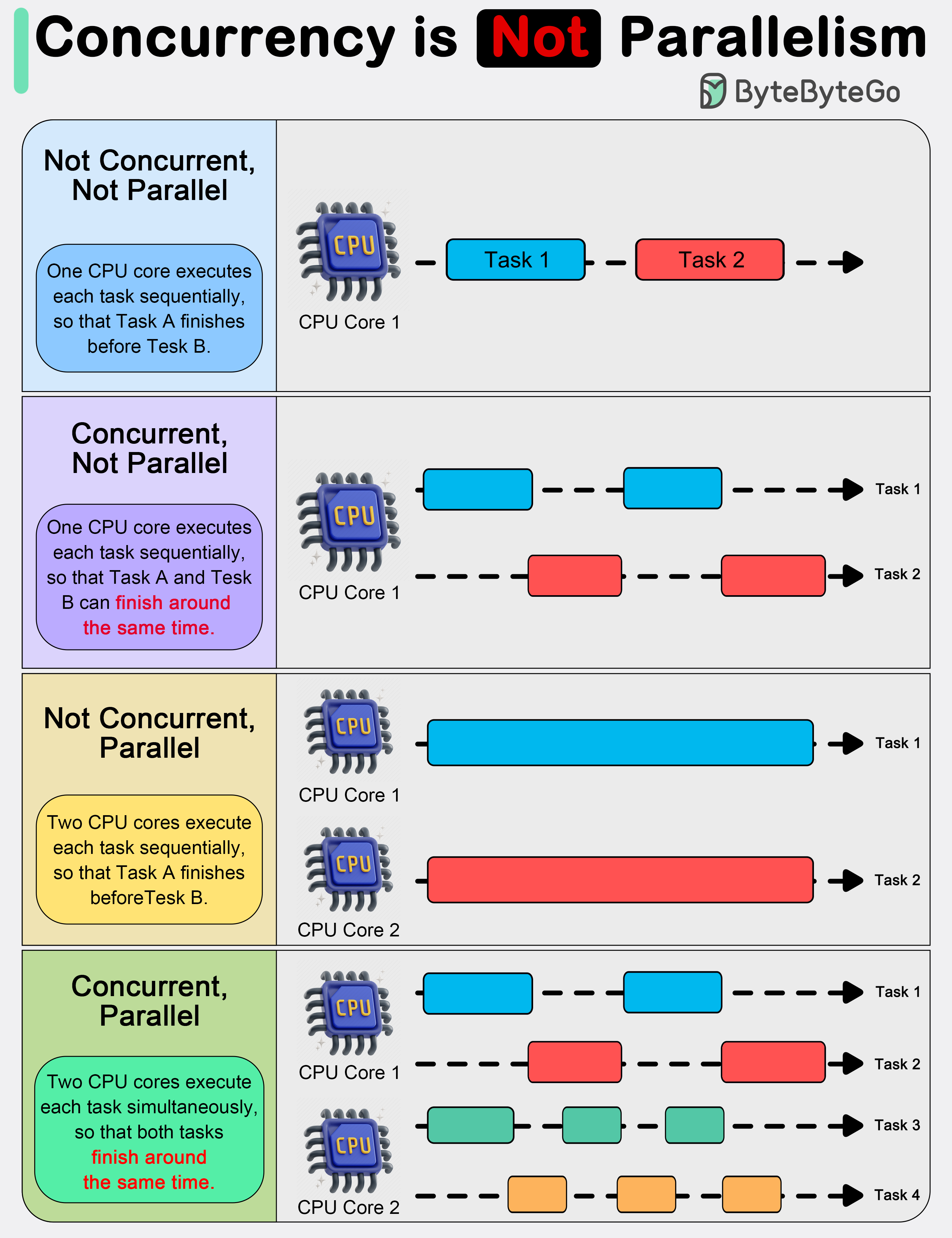
Diagram caveat
The “not concurrent, parallel” quadrant does not fit these definitions. Simultaneous execution is necessarily concurrent. The visual is useful only for contrasting interleaving with simultaneous execution.
Choosing the Execution Model
Mental Model
- I/O-bound work usually needs asynchronous APIs rather than more worker threads.
- CPU-bound work may benefit from partitioning across a measured degree of parallelism.
- Cancellation belongs to the operation’s full ownership chain.
- Shared mutable state needs an ownership rule before it needs a faster lock.
Choosing Options for the Same Requirement
The workload and failure boundary come first. The primitive comes after that.
| Requirement | Viable options | Prefer | Avoid |
|---|---|---|---|
| Many independent external I/O calls with low latency target | Sequential await, Task.WhenAll, bounded fan-out (SemaphoreSlim + WhenAll) | Task.WhenAll for moderate fan-out. Bounded fan-out when dependency limits or connection pools can saturate | Unbounded WhenAll over large sets. Parallel.ForEachAsync for pure I/O without explicit limit rationale |
| CPU-heavy per-item processing on large datasets | Sequential loop, Parallel.For / Parallel.ForEach, Parallel.ForEachAsync, PLINQ | Parallel.For / Parallel.ForEach for synchronous CPU work. Parallel.ForEachAsync only when each body is asynchronous. PLINQ for declarative batch transforms | Running heavy CPU loops directly in a hot request path without limits |
| Serialize access to shared mutable state | lock, SemaphoreSlim, Channel<T> single-consumer pipeline, immutable snapshots | lock for short synchronous sections. SemaphoreSlim for async call chains. Channel<T> when buffering or backpressure is also required | Mixing lock with async waiting patterns. Coarse global locks around I/O |
| Stop work on timeout or caller disconnect | Caller token only, CancelAfter, linked tokens | Caller token by default. Linked token when combining caller cancellation and local SLA timeout | Creating nested linked token sources inside tight loops |
| Run work beyond request lifetime | Task.Run, in-process queue (Channel<T> + BackgroundService), isolated worker with a durable broker | In-process bounded queue when admission control is enough and shared process capacity is acceptable. Isolated worker when request-serving capacity needs protection | Fire-and-forget Task.Run. Treating an in-process queue as durable or resource-isolated |
Coordination Patterns
A coordination mechanism must make ownership and failure visible. Merely removing the immediate race is not enough.
| Mechanism | Workload | Backpressure | Ownership | Cancellation | Starvation | Failure behavior |
|---|---|---|---|---|---|---|
| `Channel<T>` | Async producer-consumer handoff | A bounded channel waits or drops by policy | Writers submit. Readers drain. A single reader can own mutable state | Each wait accepts a token. Complete ends the stream | FIFO items do not imply fair writers or readers | Complete(error) exposes a terminal error. An uncaught item failure can stop the consumer pump |
| ThreadPool / `Task` | Scheduled work and async composition. CPU partitioning belongs to parallelism | None: callers must bound fan-out or queueing | The pool owns worker threads. The caller owns task observation | Cooperative through a token passed into the operation | Blocking pool workers can starve unrelated continuations | Exceptions are captured by Task and surface when observed or awaited |
| `TaskCompletionSource<T>` | Adapt one callback, event, or external completion into a task | None: it represents one completion, not a work queue | The adapter owns TrySetResult, TrySetException, and TrySetCanceled | The adapter must register cancellation explicitly | No contender-fairness guarantee. RunContinuationsAsynchronously avoids running continuations inline on the completing thread | The producer chooses exactly one terminal result. Later TrySet* calls lose the race |
| `lock` / `Monitor` | Short synchronous access to shared state | Monitor.Wait can gate a condition, but it does not bound incoming work | The entering thread owns the monitor and must exit it | lock has no token. A timed Monitor.TryEnter covers waits that must be bounded | No strict acquisition fairness. Long holders can starve contenders and form deadlocks | Exit occurs during stack unwinding, but partial state mutations are not rolled back |
Barrier | Fixed participants meeting at phase boundaries | None: every participant waits for the phase | Each registered participant must signal exactly once per phase | SignalAndWait accepts a token, but cancellation does not complete work for other participants | One delayed or missing participant stalls the phase | Post-phase callback failures surface as BarrierPostPhaseException |
ReaderWriterLockSlim | Read-heavy synchronous state with rare writes | None: queued callers only wait for ownership | The entering thread owns its read, upgradeable-read, or write lock | No token. TryEnter*Lock can impose a timeout | Writers are favored over new readers, but strict fairness is not promised | Recursion and ownership errors throw. Failed mutations still require application-level recovery |
`SemaphoreSlim` fits a concurrency limit rather than exclusive ownership. Mutex pays for an operating-system handle when ownership must cross a process boundary. Neither provides durable queueing or removes deadlock risk from a multi-lock design.
Decision Walkthroughs
Fan out 500 HTTP calls
The dependency’s capacity sets the useful fan-out, not the size of the input collection. The cap starts conservative and is tuned from latency and rejection data. When output order matters, Task.WhenAll already preserves it: its results follow the order of the supplied tasks even though completion order will vary.
public async Task<IReadOnlyList<UserDto>> LoadUsersBoundedAsync(
    IReadOnlyList<int> ids,
    int maxConcurrency,
    CancellationToken cancellationToken)
{
    using var gate = new SemaphoreSlim(maxConcurrency);

    var tasks = ids.Select(async id =>
    {
        await gate.WaitAsync(cancellationToken);
        try
        {
            return await _client.GetUserAsync(id, cancellationToken);
        }
        finally
        {
            gate.Release();
        }
    });

    return await Task.WhenAll(tasks);
}
Improve throughput of CPU transforms
Parallel.For or Parallel.ForEach fits synchronous CPU work. Parallel.ForEachAsync earns its async machinery only when each body awaits. PLINQ can keep a pure batch transform readable.
In a server, an in-process bounded queue limits admission but still consumes the same CPU and memory as request handling. Sustained CPU work needs an isolated worker process or service when request-serving capacity must be protected.
Protect shared state in an async flow
A short synchronous critical section belongs behind a lock. If ownership must span an await, SemaphoreSlim.WaitAsync can represent the gate, though holding any gate across I/O widens the contention window. A single-consumer channel is often clearer when ordered mutation and buffering are both part of the requirement.
Questions
What is the difference between concurrency and parallelism in practice?
Concurrency means several operations are in progress during the same period, even if only one runs at any instant. Parallelism means several operations run at the same instant on different cores. Parallel execution is always concurrent, but concurrent work need not be parallel.
Aspect Concurrency Parallelism What it describes How work is structured: operations overlap in time, and their steps can interleave How work executes: operations run simultaneously Hardware required Possible on a single thread or core Requires multiple cores Typical .NET use Asynchronous I/O: a thread starts an operation, yields at awaitand runs other work while the operating system waitsCPU-bound work split across cores, such as Parallel.Forover independent itemsWhat it improves Progress continues during waits, without a thread held for each wait Elapsed time of computation that divides into independent parts For example, one thread can start two HTTP requests, yield at each
awaitand resume each request when its response arrives. Both requests are in flight together, yet the thread runs one continuation at a time. Extra threads would not make the remote service respond sooner. Parallelism pays off only when there is enough independent CPU work to repay the cost of partitioning and scheduling it.Microsoft: Asynchronous programming · Microsoft: Parallel programming in .NET · Microsoft: Task-based asynchronous programming
What should be checked before choosing
Task,lock,Parallel, orChannel?Three checks drive the choice: whether the work waits on I/O or uses CPU, whether threads share mutable state, and which code owns completion, cancellation and failure.
Check Fits Reason The work mostly waits on I/O TaskwithawaitThe thread is released while the operation waits; more threads would not make the I/O finish sooner The work is independent CPU computation large enough to split Parallelwith a measured degree of parallelismSeveral cores compute at once, but small or contended work may not repay partitioning and scheduling Threads change shared mutable state in a short synchronous step lockOnly one thread at a time performs the change; a lockcannot be held acrossawaitProducers hand work to separate consumers Bounded Channel<T>It buffers items and fixes an overload policy: producers wait or items are dropped Ownership applies to every option. Some code must await or otherwise observe each task so that its exceptions surface. That code also passes a cancellation token into the operation and, for a channel, calls
Completeafter the last write. Without such an owner, a task can fail unnoticed and a channel reader can wait forever for items that will never arrive.Microsoft: Asynchronous programming · Microsoft: Task-based asynchronous programming · Microsoft: Parallel programming in .NET · Microsoft:
lockstatement · Microsoft: Channels