A monolith has one deployment boundary. Its modules are versioned, released, and rolled back together. One process and one database are common, but neither defines the style.
That shared boundary buys simple operations and cheap in-process calls. It also couples releases and scaling: a change or load spike in one module can affect the whole application.
What a Monolith Looks Like
A small ASP.NET Core monolith might have this shape:
MyApp/
├── Controllers/        # HTTP entry points
├── Services/           # Business logic
├── Repositories/       # Data access (EF Core)
├── Models/             # Domain entities
└── Program.cs          # Single startup, single deployment
One dotnet publish creates the coordinated release unit. The application may still run several processes or use more than one datastore, as long as those parts move through production together.
What the Shared Boundary Buys
Local development stays ordinary. One command starts the application, and an in-process call does not need retries, serialization, or network observability.
Transactions are also easier when modules share one transactional database. A single commit can preserve an invariant across those modules. Once a request crosses into another process or resource, the usual distributed failure modes return.
Horizontal scaling still works. Identical instances can run behind a load balancer, provided process-local state is disposable. The constraint is granularity: a hot report generator forces another copy of the entire deployment unit.
Where It Starts to Hurt
| Signal | What it exposes |
|---|---|
| A small change requires a full regression cycle | Module boundaries are weak or the release unit is too broad |
| Teams repeatedly block one another’s deployments | The shared release cadence has become an organizational bottleneck |
| One workload dominates CPU or memory | Scaling the whole application wastes capacity |
| Schema changes need coordination across modules | Data ownership is implicit |
| Failures spread across unrelated features | Isolation exists in names or folders, not at runtime |
These are coupling signals, not proof that every monolith should be split. A poorly structured service fleet can reproduce the same problems with network calls added.
The Modular Middle Ground
A Software Architecture/System Architecture/Modular Monolith keeps one deployment unit while giving each module an explicit API and data ownership. It is the usual repair when the codebase needs stronger change boundaries but independent deployment would add more operational cost than value.
Monolith vs Microservices
| Concern | Monolith | Microservices |
|---|---|---|
| Deployment | One coordinated unit | Independent service releases |
| Calls | Usually in-process | Networked and fallible |
| Transactions | Local ACID when modules share a resource | Local transactions plus explicit cross-service workflows |
| Scaling | Replicate the whole unit | Scale selected services |
| Operations | Fewer moving parts | More deployment, telemetry, and failure surfaces |
| Team cadence | Shared | Can be independent when ownership is real |
Software Architecture/System Architecture/Microservices earn their cost when independent deployment or asymmetric scaling is a repeated, measured constraint. They are a poor default for boundaries that are still changing.
When One Deployment Still Fits
One deployable unit with module boundaries enforced early is the default starting point. A split is justified only where a boundary already behaves like a service: it has stable ownership, a clear contract, and a reason to release or scale on its own.
The hard part is not extracting code. It is separating data and operational responsibility without turning every request into a distributed transaction.
Collocation Case Studies
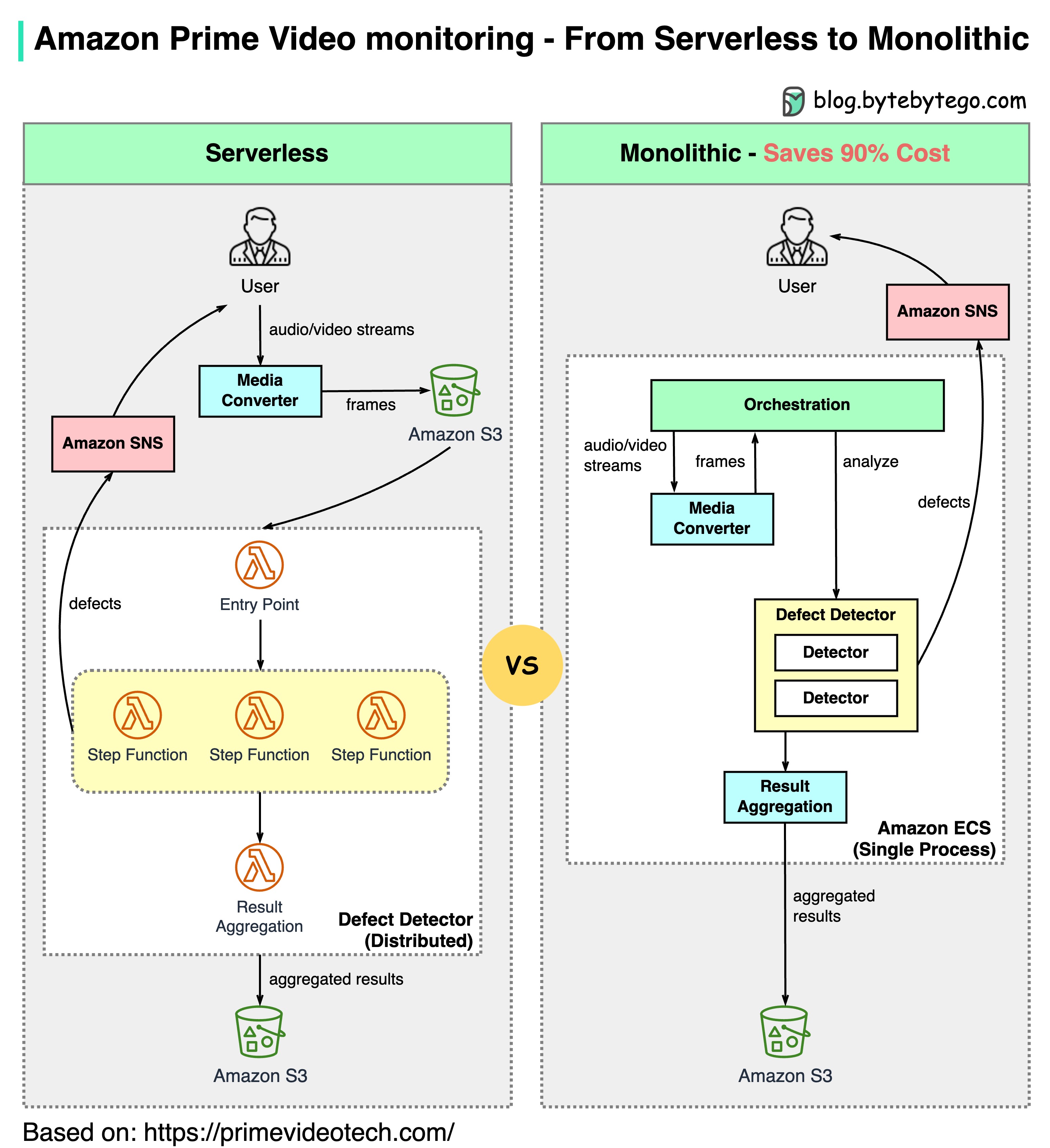
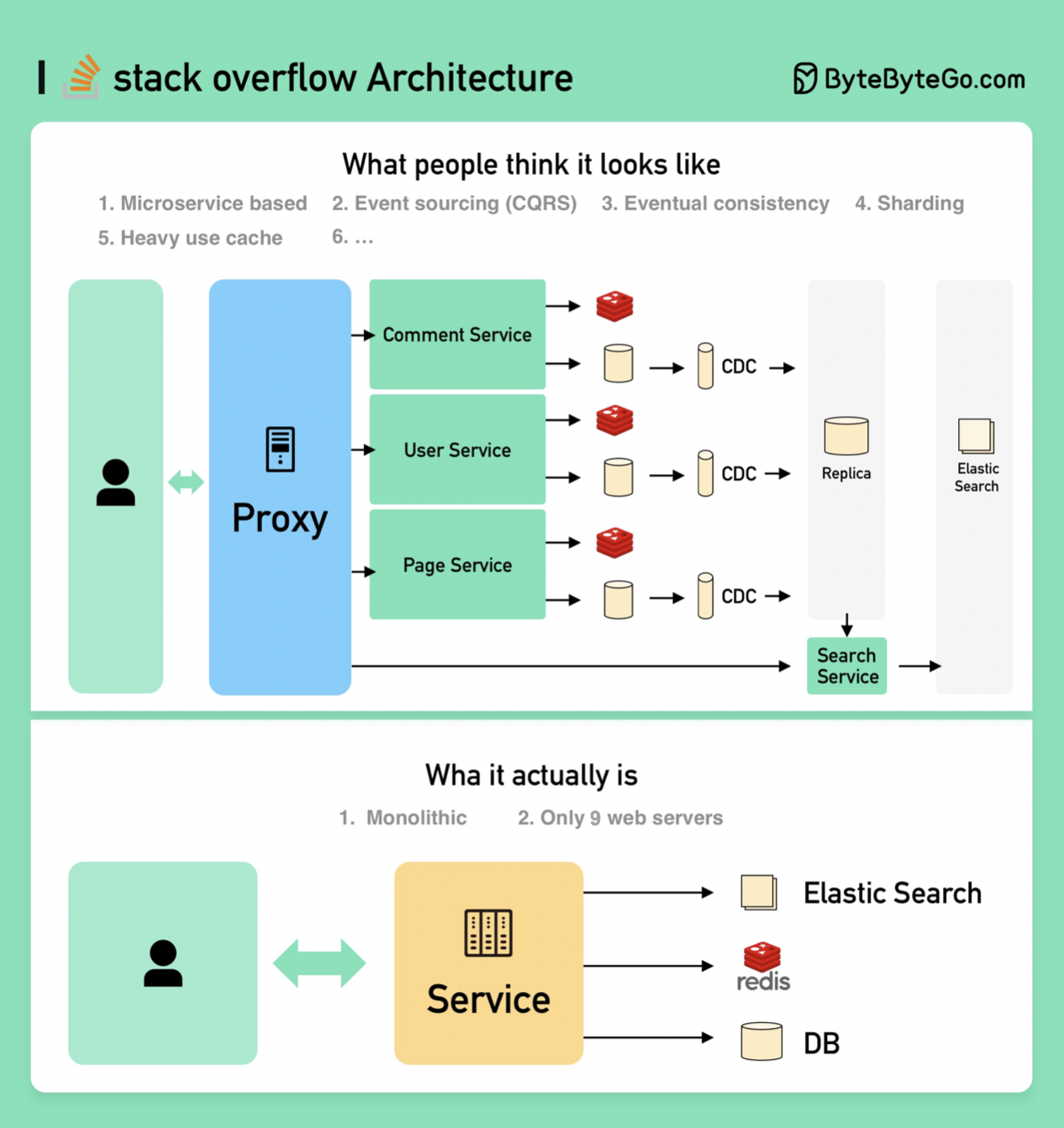
Prime Video’s monitoring pipeline and Stack Overflow’s 2016 application tier are useful cases, not universal architecture targets. Software Architecture/System Architecture/Modular Monolith develops the broader lesson: collocation can remove coordination and data-transfer costs when the boundary matches the workload.
Pitfalls
Deployment Coupling
A low-risk change can wait behind an unrelated migration because both ship in the same artifact. Module contracts and focused tests reduce accidental coupling, while feature flags separate deployment from release. Neither removes the shared rollback boundary.
Database Monolith
A shared database becomes dangerous when ownership is shared too. Each module should own its tables and expose behavior through its contract. Cross-module SQL joins save time at first, then make extraction and schema evolution expensive.
Distributed Assumptions in Local Code
Moving a module out of process changes the failure model. A method call that once completed or threw now needs timeouts, idempotency, retries, telemetry, and a plan for partial completion. Ignoring that shift produces a distributed monolith: deployment is separated, but change and failure are still coupled.
Questions
What evidence justifies extracting a service from a monolith?
Extraction is justified when a boundary is already able to stand alone and recurring, measured pressure requires it to. Without both conditions, extraction moves the coupling onto the network instead of removing it.
The boundary is ready:
- one team owns the capability and its changes;
- other code uses an explicit, stable contract instead of internal classes;
- the capability exclusively owns its data, and no other module reads or writes those tables directly.
There is recurring pressure for independence:
- its changes repeatedly wait for unrelated releases;
- its load needs to scale separately from the rest of the application;
- its failures or resource use need runtime isolation from other features.
When the pressure is missing, the network hop buys no autonomy that matters. The coupling that was visible in code becomes operational coupling, with added latency, partial failure and another deployment to run. When the boundary is not ready, shared tables or paired releases make the extracted service part of a distributed monolith.